New Laser Ion Source for Brookhaven Accelerators Exceeds Expectations

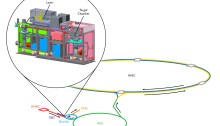
Microwaving popcorn never quite turns out right. Inevitably, some kernels remain unpopped while others burn. Scientists at the U.S. Department of Energy’s Brookhaven National Laboratory were experiencing a similar phenomenon with their ion source, the device that feeds singly ionized atoms into the particle accelerators that supply beams to the Relativistic Heavy Ion Collider (RHIC) and the…
Brookhaven Lab’s Upendra Rohatgi Receives ASME’s Globalization Medal for International Nonproliferation Work

UPTON, NY — The American Society of Mechanical Engineers (ASME) has awarded the Technical Communities Globalization Medal to Upendra S. Rohatgi, a senior mechanical engineer at the U.S. Department of Energy’s (DOE) Brookhaven National Laboratory. He received the award for work helping to steer scientists formerly engaged in designing weapons of mass destruction toward more…

Moderate flu season winds down

Minnesota has reached the tail end of a moderate flu season — welcome relief after 2012-13, one of the deadliest flu outbreaks in years. The state has recorded 1,484 hospitalizations from influenza so far this year, compared to more than 3,000 last year, according to the Minnesota Department of Health’s weekly update. No one under…

‘Fiscal cliff’ could hurt U research

All Vice President for Research Tim Mulcahy can do is watch, wait and hope for good news. With time running out for Congress and President Barack Obama to reach a compromise before looming automatic tax increases and spending cuts send the federal budget over a fiscal cliff, Mulcahy says the University of Minnesota’s research budget…

U.S. minorities exposed to more toxic air, U finds

Minorities across the country are exposed to more of a dangerous air pollutant than whites, resulting in thousands of preventable deaths due to heart disease, according to a University of Minnesota study. The study, published Tuesday in the journal PLOS ONE, found that nonwhites are exposed to 38 percent more nitrogen dioxide, one of six…

Research labs repair their own equipment to save money

When the gas chromatograph spectrophotometer broke late last summer, it was Grant Wallace’s job to fix it. The instrument, which the University of Minnesota graduate student is using to measure the tiny products of pesticide reactions, is more than 10 years old, and its manufacturer no longer offers repair services. With the help of a…