
The fashonista physicist
Theoretical physicist Ágnes Mócsy teaches art students science.
Theoretical physicist Ágnes Mócsy teaches art students science.

Yes — until it’s not. And these experts say that’s the problem.

Eric Wilson was flying an F18 fighter jet at 28,000 feet when he heard a loud bang, and everything went silent. The jet had lost all cabin pressure, immediately subjecting the U.S. Marine’s body to an onslaught of altitude induced issues. He only had about 60 seconds to descend below 10,000 feet or he would…

“Academic science isn’t sexist,” claim two psychologists from Cornell University in a recent New York Times Sunday Review. To most women in academia, that’s absurd. I started reading this column in the paper, and abruptly stopped because that’s not what I, or any woman I know, experienced. I was relieved to see the blogosphere buzzing with…
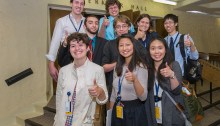
This year’s crop of Brookhaven National Laboratory summer interns have come and gone, once again invigorating the Lab with their energy and passion for science, technology, engineering, and mathematics (STEM) research. Coming from universities across the country, more than 180 interns worked on research projects in every corner of the U.S. Department of Energy (DOE)…

Sometimes all it takes for a girl to get interested in science is experiencing it hands-on — like documenting the health of a pond ecosystem by tracking animals, or understanding the physics of static electricity by feeling her hair stand up on end. Seeing the science in action, along with hearing encouragement to learn more…

The familiar lighter-than-air gas filling birthday balloons has a rare isotope: a nucleus consisting of two protons and a single neutron called helium-3. But instead of using this gas for fanciful decorations, scientists at the U.S. Department of Energy’s (DOE) Brookhaven National Laboratory made use of its interesting triangular shape in a new series of…

A single sensor for the world’s largest digital camera detected light making its way through wind, air turbulence, and Earth’s atmosphere, successfully converting the light into a glimpse of the galactic wonders that this delicate instrument will eventually capture as it scans the night sky. When installed in the camera of the Large Synoptic Survey…
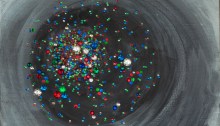
When gold ions collide inside the Relativistic Heavy Ion Collider (RHIC) to replicate the conditions that existed just after the Big Bang, temperatures can reach 4 trillion degrees Celsius, the initial energy can soar up to 200 billion electron volts per nucleon, and it all takes place within a billionth of a trillionth of a second. Naturally,…
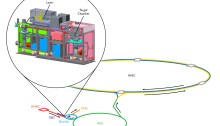
Microwaving popcorn never quite turns out right. Inevitably, some kernels remain unpopped while others burn. Scientists at the U.S. Department of Energy’s Brookhaven National Laboratory were experiencing a similar phenomenon with their ion source, the device that feeds singly ionized atoms into the particle accelerators that supply beams to the Relativistic Heavy Ion Collider (RHIC) and the…
 Rebecca Harrington